How to Protect Your Business from the Inevitable Attack Without Breaking the Bank





- Are you worried about the growing risks stemming from the evolving cyber threat landscape that will undoubtedly one day impact your business?
- Are you tired of paying for the high cost of your BC/DR provider to evaluate, procure, integrate, manage, and operationally maintain countless point solutions to protect your data, applications, and infrastructure?
- For a reliable, cost-effective solution for ensuring business continuity and disaster recovery, look no further than Tehama.
Don’t become a statistic
According to the 2021 Hourly Cost of Downtime survey by ITIC, over 90% of mid-sized and large businesses experience costs exceeding $300,000 for an hour of downtime. In the current cybersecurity landscape, businesses must have business continuity and disaster recovery (BC/DR) to prepare for the inevitable risk of cyber threats.
Maintaining seamless operations without jeopardizing their data, applications, or reputation in the event of an outage or breach is a top priority. The challenges of providing highly available, secure access to data and applications for hybrid and remote workers is a constant risk for CISOs, IT security teams, and technology service providers. BC/DR is complex and challenging to deploy, requires a lot of time and money, and involves significant investments in infrastructure and personnel.
A game-changing BC/DR ensures you don’t become a statistic
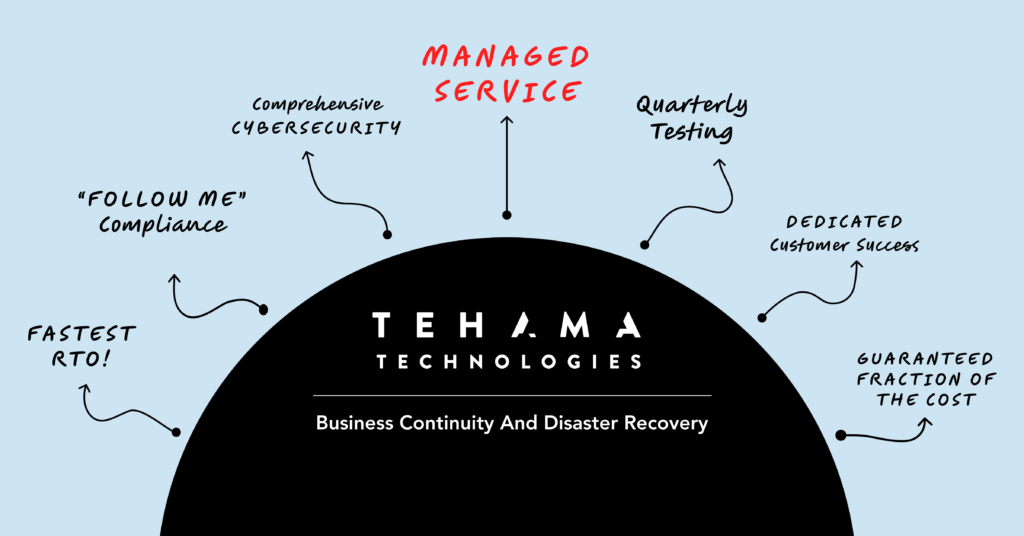
Tehama’s BC/DR is a game-changer, delivering an enterprise-level service regardless of whether you are a small, medium, or large enterprise. Delivered as a managed service, Tehama’s BC/DR provides the fastest RTO with secure and immediate access to vital business data and applications for remote and hybrid workers during an outage or catastrophe. Tehama is easy to implement, provides fast time-to-value with minimal operational overhead, offers greater flexibility, reduces risk, and dramatically improves security posture.
Create an effective BC/DR plan
In order to ensure your BC/DR service is correctly aligned to your business objectives and risk profile, Tehama’s customer success organization collaborates with you to develop a detailed plan. The plan will include the following components:
1. Assess Risk.
A comprehensive risk assessment to identify vulnerabilities and potential threats to your data, application, and IT infrastructure. Prioritize these risks in terms of probability and impact.
2. Key Objectives and Metrics.
Establish Recovery Time Objectives (RTO) and Recovery Point Objectives (RPO). Determine acceptable downtime and potential data loss.
3. Data Backup Strategy.
Implement regular on-site and off-site backups.
4. Recovery Procedures.
Creating step-by-step recovery procedures and detailed runbooks for various disaster scenarios to guide you through the recovery process.
5. Infrastructure Redundancy.
Reducing instances of system downtime using failover systems and redundant data centers.
6. Communication Plan.
Keeping stakeholders informed during an incident by developing a communication plan with a chain of command and protocols.
7. Testing and Drills.
Regularly validating the plan’s effectiveness by conducting periodic drills and updating the plan based on findings.
8. Compliance and Documentation.
Align with industry regulations and update documentation according to standards such as GDPR and HIPAA.
Tehama’s managed service delivers your BC/DR plan uniformly across the enterprise, ensuring policy-based protection of data, applications, and users on the basis of your risk profile, prioritization, and potential impact on the business, whether reputational or financial.
Workforce continuity
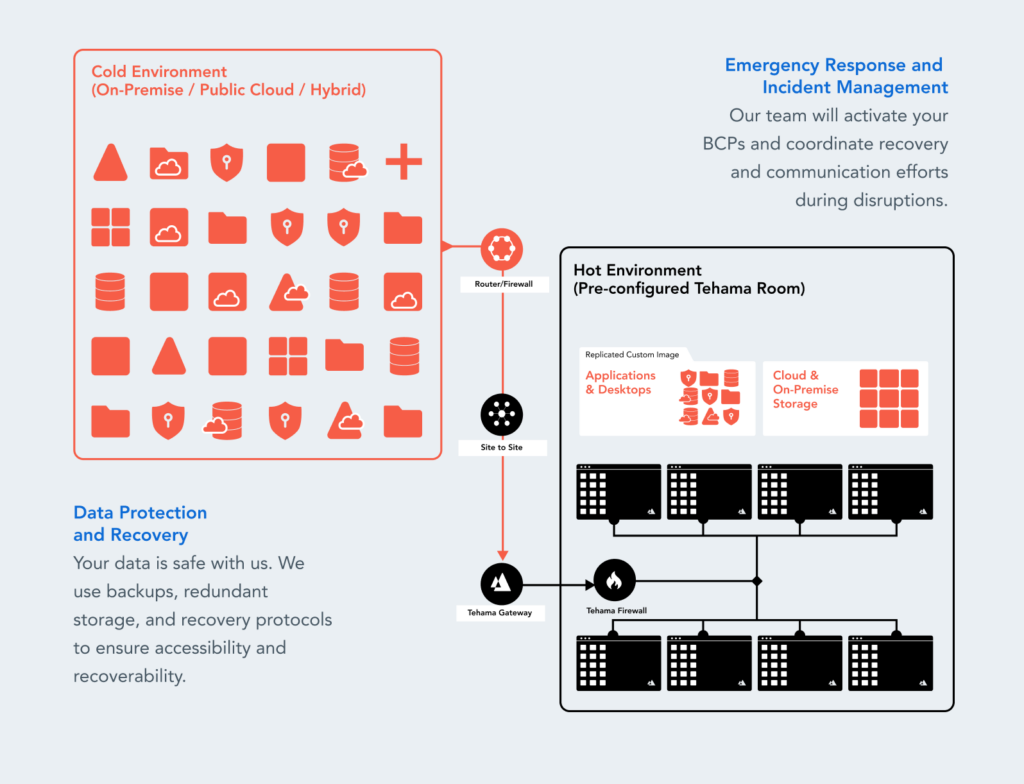
With Tehama’s BC/DR solution, hybrid and remote workers can return to work immediately following an incident. Users can quickly access their BC/DR failover (hot) virtual environment with just a few mouse clicks. This dedicated environment provides virtual workstations that are backed up and offer access to recover and continue end users’ work without any loss of data or productivity impact. The authentication process is completed within minutes, ensuring a seamless transition to the failover environment.
Download the full datasheet here.
Compliance and Regulatory Continuity
Tehama’s “follow-me” compliance capabilities incorporate full compliance controls, such as SOC2 II, and user and security configuration policies. Additionally, conditional-based access offers peace of mind to enterprises.
Don’t break the bank
Built on Tehama’s robust P5 architecture, Tehama’s managed service provides you with a highly resilient, enterprise-quality, and cost-effective BC/DR service. The unique approach of integration, automation, and security ensures that, unlike other solutions or services, we remove the burden of individually evaluating, procuring, integrating, managing, and maintaining siloed technologies, which can be tedious.
With Tehama, your organization will gain secure access to restored data and applications, whether on-premises or in the cloud. Our rapid roll-out capabilities enable you to scale up to meet capacity requirements quickly, significantly reducing downtime-related costs following an incident.
We’ve got your back
Ultimately, Tehama’s BC/DR solution ensures businesses can be confident that their business continuity requirements are being addressed in such a way that their risk profile is mitigated against all potential challenges the business will face.
Contact us today to learn how Tehama distinguishes itself from the competition by simplifying business continuity and driving efficiency. We welcome the opportunity to discuss your specific requirements in greater detail.
To learn more about Tehama’s managed service go to our Business Continuity page and download the datasheet.

Read More

A Checklist Tells You the Architecture Is Sound. It Doesn't Tell You It's Still Holding.
Self-Custody Is What BYOC Looks Like When the Workload Is a Compliance Boundary