






Driving Better Business Outcomes with SASE





Why Architecture, Not Adoption, Determines the Outcome
Secure Access Service Edge has moved quickly from concept to expectation. Most enterprise security teams are familiar with it. Many have started the journey, and a growing number would say they have already adopted it. Yet outcomes remain uneven.
Some organizations see real gains. Simpler operations, stronger access control, better performance for distributed teams. Others find themselves in a familiar place: more tools, more complexity, and a growing sense that something is still missing.
The difference is rarely about intent. It comes down to how SASE is approached and what sits around it.
Why SASE Still Matters
Enterprise environments have changed in ways that are now irreversible. Applications are no longer centralized. They live across SaaS platforms, public cloud, private infrastructure, and partner environments. Users are no longer limited to employees on managed devices. They include contractors, vendors, service providers, and offshore teams, often working across multiple locations and networks.
The old model assumed a boundary. Inside the network, you were trusted. Outside, you were not. That assumption no longer holds.
SASE emerged to address this shift. It brought networking and security closer together and moved control toward identity rather than location. Access could be granted based on who the user is, what they need, and the context of the request, not simply where they happen to be connecting from. That shift is still essential. It is also incomplete.
What SASE Actually Changes
At its best, SASE changes how access is handled. It reduces reliance on VPNs and static network controls. It introduces identity-aware access to applications and applies policy more consistently across users and environments. Traffic gets routed more intelligently, which matters for performance across a distributed workforce.
These are meaningful improvements. They address real problems that enterprises have struggled with for years. But they operate primarily at the point of access.
SASE secures access. It does not govern what happens next.
SASE improves how users connect to applications by enforcing identity-aware access and reducing reliance on the network perimeter. But once access is granted, most environments still depend on application controls and network segmentation to limit risk. In regulated or high-risk environments, that gap becomes the problem.
Where SASE Starts to Break Down
Most SASE initiatives do not fail outright. They stall. The signs are familiar: multiple tools assembled in the name of convergence, identity systems that remain fragmented, policies applied inconsistently across environments. Teams struggle to maintain a clear picture of who has access to what and why. Over time, complexity shifts rather than disappears.
There is also a more subtle issue. Even when access is tightly controlled, the environment behind that access is often not. Once a user is in, the burden shifts to application-level controls or network segmentation to prevent misuse, data exposure, or lateral movement. That approach works up to a point. Beyond that point, it introduces risk that is difficult to manage, especially when external users are involved.
Why Access Alone Is Not Enough
It is easy to assume that if access is controlled, the problem is solved. In practice, access is only the first step.
Consider a contractor working on a sensitive project. Or a third-party service provider supporting a critical system. Or a research team handling proprietary data. In each case, the question is not just whether they should have access. It is what happens once they do. Can data move outside controlled environments? Is activity fully visible and attributable? Can one system be used to reach another?
These are not edge cases. They are the scenarios most likely to surface in audits, investigations, and incident response. This is where many SASE deployments reach their limit.
Adding Isolation to the Model
To address this gap, some organizations are introducing a second layer. Not another tool, but a different way of structuring interaction with systems and data. Instead of connecting users directly to applications, users interact through controlled environments.
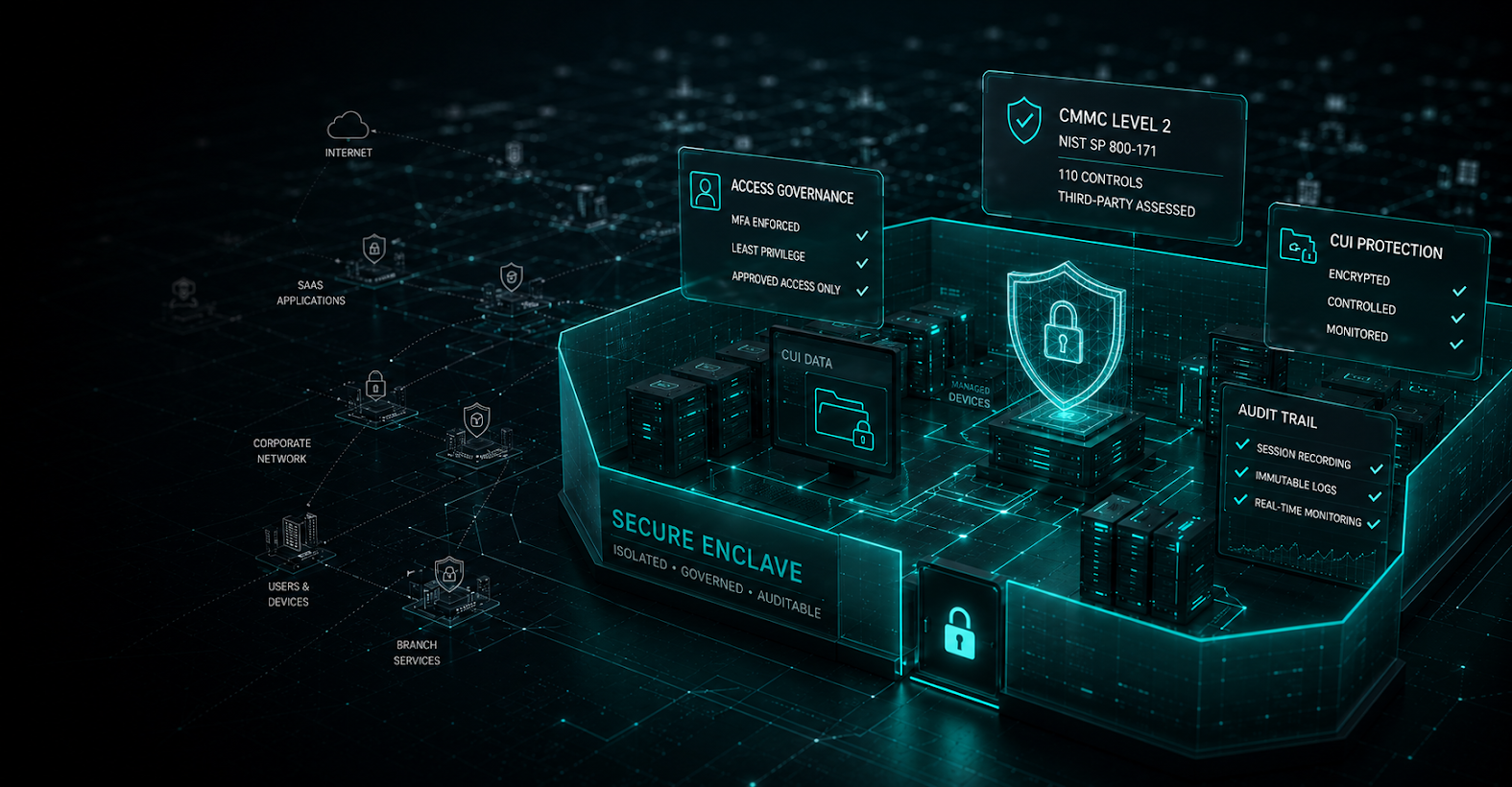
These environments, often referred to as enclaves, isolate workloads from endpoints and from each other. Users operate within them rather than reaching into core systems from the outside. Data remains inside the environment. Activity can be monitored consistently. Policies are enforced at the environment level, not just at the point of access. Movement between systems is constrained by design, not just by configuration.
SASE controls how access is granted. The enclave controls what can happen next.
Why This Matters for Regulated Environments
In many industries, this distinction is becoming critical. Healthcare organizations must account for how patient data is accessed and handled across a growing network of partners. Financial institutions need to demonstrate not only that access is controlled, but that activity is auditable. Defense contractors are expected to show clear boundaries around sensitive workloads.
In each case, the expectation is the same. Security must be enforceable, observable, and provable. Relying solely on access control makes that difficult. Introducing isolation makes it achievable.
The Role of the Network Itself
There is another layer that is often overlooked. Even when access is controlled and workloads are isolated, data still moves across networks. Those networks remain visible and, in many cases, targetable. Traditional approaches rely on encryption and fixed paths. While effective, they still expose patterns that can be observed, disrupted, or exploited.
Newer networking approaches change the equation. Techniques such as multipath fragmentation and dynamic routing split traffic, obfuscate it, and transmit it across multiple paths simultaneously. There are no fixed tunnels to discover and no stable patterns to analyze. The goal is not just to protect data in transit but to reduce what an adversary can observe in the first place.
For organizations operating in high-risk environments, that distinction matters.
Where Tehama Fits
Tehama was built around the idea of controlled environments. The platform provides secure cloud enclaves where users, applications, and data are brought together under consistent policy and governance. Access is verified, activity is logged, and sensitive workloads remain contained.
For organizations that have already begun their SASE journey, Tehama provides a way to extend that model beyond access. It introduces structure where environments are currently open, simplifies how third-party access is handled, and provides a clearer path to demonstrating compliance in environments where auditability is no longer optional.
In practice, it allows organizations to move from securing connections to governing interaction.
Architecture Over Adoption
There is no single step that completes a SASE strategy. The organizations seeing the most success tend to move incrementally. They start by understanding their applications and access patterns. They apply identity-based access where it matters most. They introduce isolation for sensitive workloads. And they evolve their network approach as risk demands it.
What they do not do is treat SASE as a finished state.
SASE remains a valuable model. It addresses real challenges and continues to shape how modern enterprises approach secure access. But access alone does not define security. As environments become more distributed and more interconnected, the focus shifts. From who can connect, to what happens after they do. That is where architecture matters.

Read More
Beyond the Compliance Calendar: How the Enclave Model Transforms Subcontractor Risk, AI Adoption, and Competitive Positioning
Your Enclave, Your Keys: The Self-Custody Model That Removes Vendor Trust from the Equation