






Beyond the Compliance Calendar: How the Enclave Model Transforms Subcontractor Risk, AI Adoption, and Competitive Positioning




CMMC SERIES · PART 3 OF 3
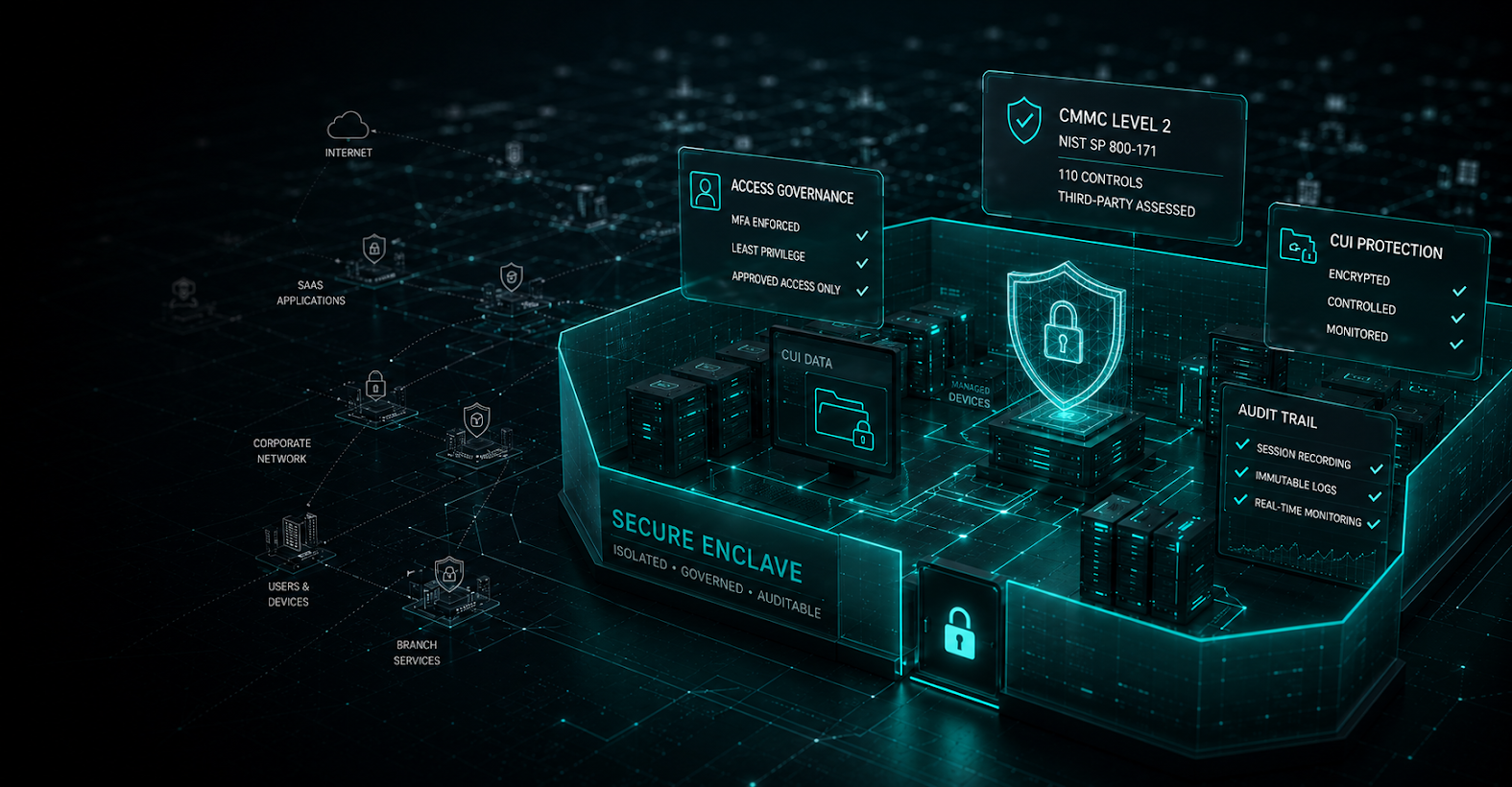
CMMC compliance has traditionally been framed as a cost of doing business. The organizations adopting a sovereign enclave strategy are discovering it can be something else entirely: a capability that accelerates contract pursuit, simplifies partner onboarding, and enables safer adoption of emerging technology.
The first two posts in this series focused on the compliance architecture: why traditional network environments create sprawling assessment scope, and how Self-Custody Data Enclaves establish a cleaner, more defensible CUI boundary by design. This post was written before the Department of War’s July 13, 2026 announcement suspending CMMC Phase II requirements pending a 60-day review. On reflection, that announcement makes this post more relevant, not less.
What the July 13 release makes clear is that the underlying obligation to protect Controlled Unclassified Information isn’t going anywhere. DFARS clause 252.204-7012, which requires contractors to safeguard covered defense information, remains explicitly in force. NIST SP 800-171 self-assessment requirements remain in place. What changed is the mechanism and timeline of third-party verification, not the security standard itself. Organizations that built their compliance posture around a certification date now have to reconsider their timeline. Organizations that built it around a defensible architecture have nothing to reconsider.
The three areas where the operational impact of that architecture tends to be most pronounced are subcontractor management, AI adoption, and the speed at which compliant environments can be deployed in response to new contract opportunities. Each represents a genuine operational problem that the legacy patchwork approach handles poorly, while the enclave model, by its design, handles well regardless of which assessment regime is in place.
Managing the Supply Chain Without Inheriting Its Risk
Subcontractor management is one of the genuinely hard problems in CMMC compliance for defense primes, and it’s one that doesn’t get enough attention in discussions of the certification framework. Primes are typically responsible for ensuring that their sub-tier vendors handle CUI compliantly, which in practice means either extending their own secure environment to those partners (expanding scope and risk in the process) or requiring each subcontractor to build and certify their own compliant infrastructure (which is prohibitively expensive for smaller vendors and creates significant onboarding delays on both sides). Neither option scales well for a business that relies on a dynamic supply chain, and neither provides the continuous audit visibility that compliance assessors, whether internal or third-party, expect to see.
With a Tehama Enclave and its third-party organizational awareness, a prime can provision a dedicated Project Enclave for a specific contract engagement and invite subcontractor personnel to work inside it from their own devices. The subcontractor connects through the same encrypted presentation layer that governs all enclave access, so all CUI remains within the prime’s governed boundary at all times. It never touches the subcontractor’s device, their network, or any system outside the prime’s custody. The subcontractor effectively inherits the prime’s CMMC security posture for the duration of the engagement without needing to build, audit, or maintain their own compliant environment. The prime retains complete visibility into every session, every data access, and every action taken by external personnel within the enclave.
The per-project enclave architecture carries an additional benefit when a prime is running multiple concurrent engagements. Each contract’s CUI stays cleanly separated, auditable on its own terms, and scoped only to the personnel working on that specific engagement. Personnel on one project have no visibility into another. An auditor reviewing a specific contract sees a clean, bounded evidence trail for that engagement only, with no risk of CUI from one program bleeding into the access scope of another simply because the underlying infrastructure is shared.
This is the same principle that governs why subcontractors are brought into a specific project environment rather than invited onto the prime’s broader network. The logic extends naturally to the CUI problem: just as you would not grant a partner access to your whole network to give them access to one project, you would not consolidate multiple CUI contracts into a single environment when each carries its own controls, obligations, and audit surface. Per-project enclaves make that separation structural rather than procedural.
When the contract ends, access is revoked, and the enclave can be terminated. Nothing is left behind on the subcontractor’s devices. No audit trail gaps are created by the handoff. The compliance boundary remains clean and unambiguous throughout the relationship, which is exactly what an assessor needs to see when evaluating the prime’s management of its supply chain.
When the engagement ends, the prime revokes access or terminates the enclave entirely. No CUI remains on a subcontractor’s device, no audit trail gaps are created, and no residual exposure lingers. This is supply chain compliance that actually works at scale, not because it requires sub-tier vendors to build their own secure infrastructure, but because it brings them inside an environment that already meets the standard.
AI Adoption Without the Compliance Exposure
Artificial intelligence tools are increasingly relevant to defense contractors, covering data analytics, predictive maintenance, contract analysis, strategic planning, and a range of other applications that were simply not practical at scale a few years ago. The problem is that feeding Controlled Unclassified Information into a public or commercial AI model introduces risks that the existing regulatory framework wasn’t designed to address: data leakage into training sets, loss of control over derivative outputs, the possibility that model responses could expose sensitive information to external parties, and the broader question of whether the AI provider’s data handling practices are consistent with DFARS and CMMC obligations. For most DIB organizations, the answer today is either to avoid AI tools in CUI contexts entirely, forgoing a genuine operational advantage, or to accept compliance exposure that isn’t well-defined or well-understood.
A Tehama Enclave provides a third option: a governed sandbox for AI adoption where the compliance controls that apply to other CUI interactions apply equally to AI model use. Data used for inference or analysis stays strictly inside the enclave boundary, subject to the same egress controls and deny-by-default networking that govern all other data movement. Strict egress controls prevent outputs that may contain sensitive derivative information from leaving the environment without authorization. Organizations can evaluate and deploy AI capabilities at a pace that the competitive environment increasingly demands, without expanding their compliance scope or depending on the regulatory framework to resolve questions about AI and CUI that it hasn’t yet fully addressed.
For organizations that need to go further, the enclave model supports the complementary posture: a governed environment where AI tools are fully available but CUI is structurally excluded from ever entering it. Personnel working in a low-side enclave can use AI for analysis, drafting, research, and decision support without restriction, precisely because the architecture ensures sensitive data never reaches the model in the first place. The compliance question doesn’t arise because the exposure is impossible by design, not prohibited by policy.
Running both environments in parallel, a high-side enclave for governed AI use alongside CUI and a low-side enclave for unrestricted AI use without it, gives defense contractors something the legacy infrastructure approach cannot deliver: a clean, auditable boundary between the two, with no shared infrastructure that could blur the line. Each environment carries its own access controls, its own Activity Stream, and its own audit trail. The posture each one represents is demonstrable independently.
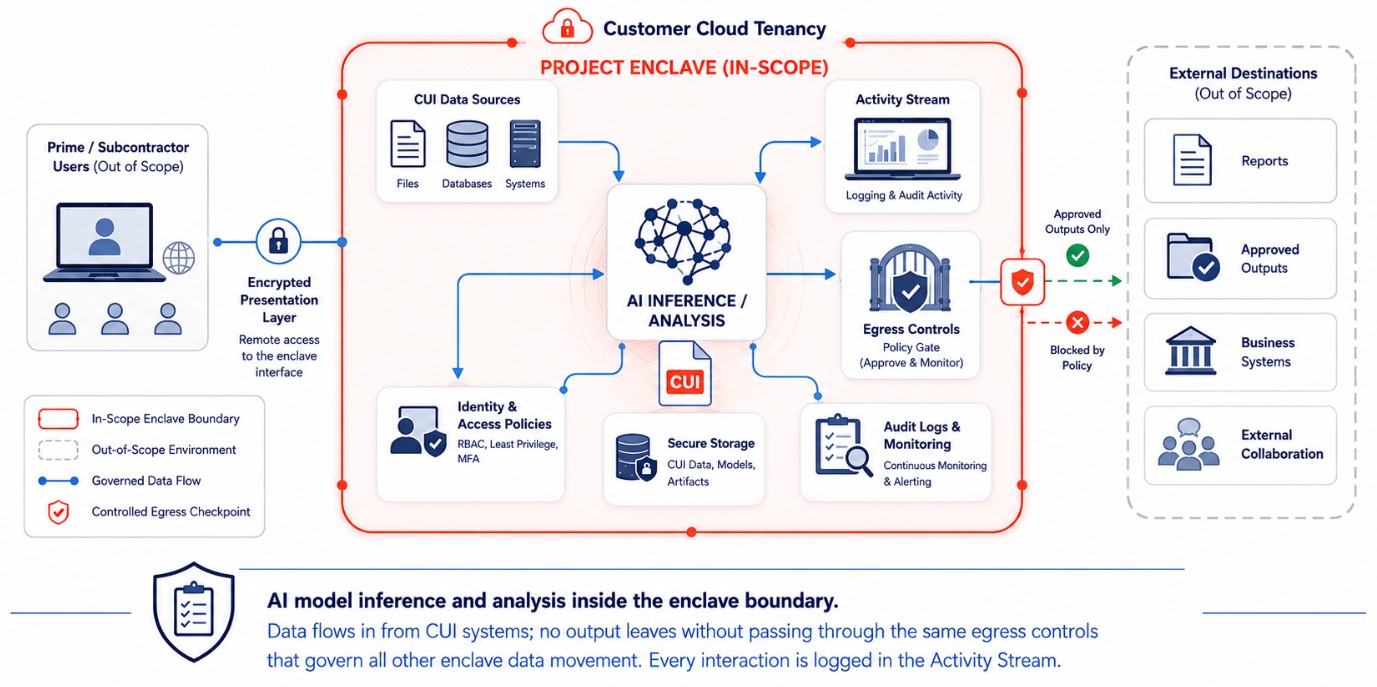
AI model inference and analysis inside the enclave boundary. Data flows in from CUI systems; no output leaves without passing through the same egress controls that govern all other enclave data movement. Every interaction is logged in the Activity Stream.
Speed as a Competitive Advantage
Traditional approaches to building a compliant environment, which involve procuring and shipping hardened hardware, configuring VPN infrastructure, hardening VDI servers, and integrating bolt-on security tools, take months to stand up and require significant ongoing engineering effort to maintain. That timeline has real business consequences for contractors trying to respond to opportunities in a market where contract timelines are tight and prime contractors increasingly expect their supply chain partners to demonstrate CMMC readiness before engagement begins, not after.
Tehama Enclaves can be provisioned in minutes, with pre-configured controls already mapped to NIST 800-171 requirements. A contractor who has deployed the enclave architecture can respond to a new contract opportunity knowing that the secure, compliant infrastructure required to perform the work can be available immediately upon award, not months later, after the hardware arrives, the VPN is configured, and the SIEM is integrated. That agility matters in competitive evaluations, and it matters in the operational reality of managing multiple concurrent engagements with different security requirements and different partner communities.
The ability to spin up a compliant CUI environment in days rather than months isn’t just an operational convenience. It changes the competitive calculus. Organizations that can demonstrate immediate readiness are better positioned in contract evaluations, better equipped to respond to surge requirements, and better able to scale their engagement with the defense industrial base without the compliance burden growing proportionally with the business.
The Compliance Posture That Becomes a Differentiator
Taken together, these operational advantages represent something that the defense contracting community is only beginning to articulate clearly: CMMC compliance, properly implemented through a sovereign enclave strategy, is not just a regulatory obligation. It’s a business capability. The organization that can onboard a new subcontractor into a compliant environment within hours, deploy a governed sandbox for AI-enabled analysis without creating compliance exposure, and respond to a new contract opportunity with a fully provisioned secure infrastructure already in place is competing differently than the organization still wrestling with how to harden its legacy network to a standard it was never designed to meet.
The DIB organizations that recognize this earliest, investing in an architecture built around a clean, sovereign compliance boundary rather than a proliferation of bolted-on tools, are the ones best positioned regardless of how the CMMC program evolves from here. Whether Phase II returns in its current form, emerges from the 60-day review in a revised form, or is replaced by something else entirely, the underlying obligation to protect CUI under DFARS 252.204-7012 and NIST 800-171 doesn’t change. The architecture either supports that obligation or it doesn’t. That’s a different conversation than the one most contractors are having today, and it starts with asking a different question: not “how do we prepare for the next assessment deadline?” but “how do we build an environment that demonstrates real security maturity, regardless of which evaluation framework is in place when the auditor arrives?”
Your Enclave. Your Keys. Our Platform.
Tehama Technologies helps defense contractors and DIB organizations protect Controlled Unclassified Information and demonstrate real cybersecurity maturity through Self-Custody Data Enclaves. To learn more or request a briefing, visit tehama.io.
Read the full series: Part 1: The Scope Trap · Part 2: The Self-Custody Model

Read More
A Checklist Tells You the Architecture Is Sound. It Doesn't Tell You It's Still Holding.
Self-Custody Is What BYOC Looks Like When the Workload Is a Compliance Boundary