Why Zero Trust Access Can’t Be an Afterthought Anymore




The cybersecurity landscape has changed—but too many organizations are still relying on outdated assumptions.
Assumptions like: once you’re inside the network, you’re safe.
Or: the VPN is enough.
Or: breach risk only comes from the outside.
In a cloud-first, hybrid-everything world, these assumptions don’t hold.
Whether you’re managing distributed workforces, integrating third-party contractors, or operating across multi-cloud infrastructure—one truth is clear: A Zero Trust strategy with end-to-end, uniform, policy-based compliance, auditing and reporting is critical to an organization’s threat management and mitigation strategy.
The Problem with Legacy Perimeter Thinking
Traditional security models operate like castles: strong walls, deep moats, and a gatekeeper. But once someone gets inside—even accidentally—all bets are off. In the age of insider threats, remote work, and AI-powered attacks, that perimeter approach just doesn’t cut it.
Data is no longer confined to one network, one office, or one device. Today, enterprise data flows across public clouds, remote endpoints, and third-party vendors. You can’t rely on the perimeter when the perimeter doesn’t exist.
And while many companies claim to implement “Zero Trust”, their setups are still riddled with a patchwork of tools: VPNs, endpoint agents, firewalls. Each solving a sliver of the problem. None offering true control over how, where, or by whom data is accessed.
What True Zero Trust Access Looks Like—And Why Tehama Is Different
Tehama doesn’t just claim Zero Trust—we bake it into every session, every connection, every workspace. Our cloud-native platform establishes fully governed, secure access environments in hours—not weeks.
Here’s what real Zero Trust looks like in practice:
- No implicit trust: Whether it’s a contractor, an employee, or a partner, no one gets access without identity verification, endpoint validation, and enforced policy controls.
- Least privilege by default: Users only get access to what they need—nothing more. Access to files, systems, and apps is provisioned based on roles, context, and risk.
- Strong authentication at every step: Multi-factor authentication (MFA), device posture checks, and IP-based policies are all built-in—no integrations required.
- Segmentation that works: Microsegmentation is native. Every Tehama Room is a fully isolated environment, with its own virtual network, storage, and policy stack.
- Full auditability: Every action is logged. Every file movement, every login, every permission change—recorded and attributable.
- No endpoint risk: Data never touches the local device. Even on BYOD or unmanaged endpoints, Tehama ensures sensitive data stays in the cloud—eliminating exfiltration risk.
Tehama’s Zero Trust, Powered by Design
What sets Tehama apart isn’t just what we secure—it’s how fast and frictionlessly we help you do it.
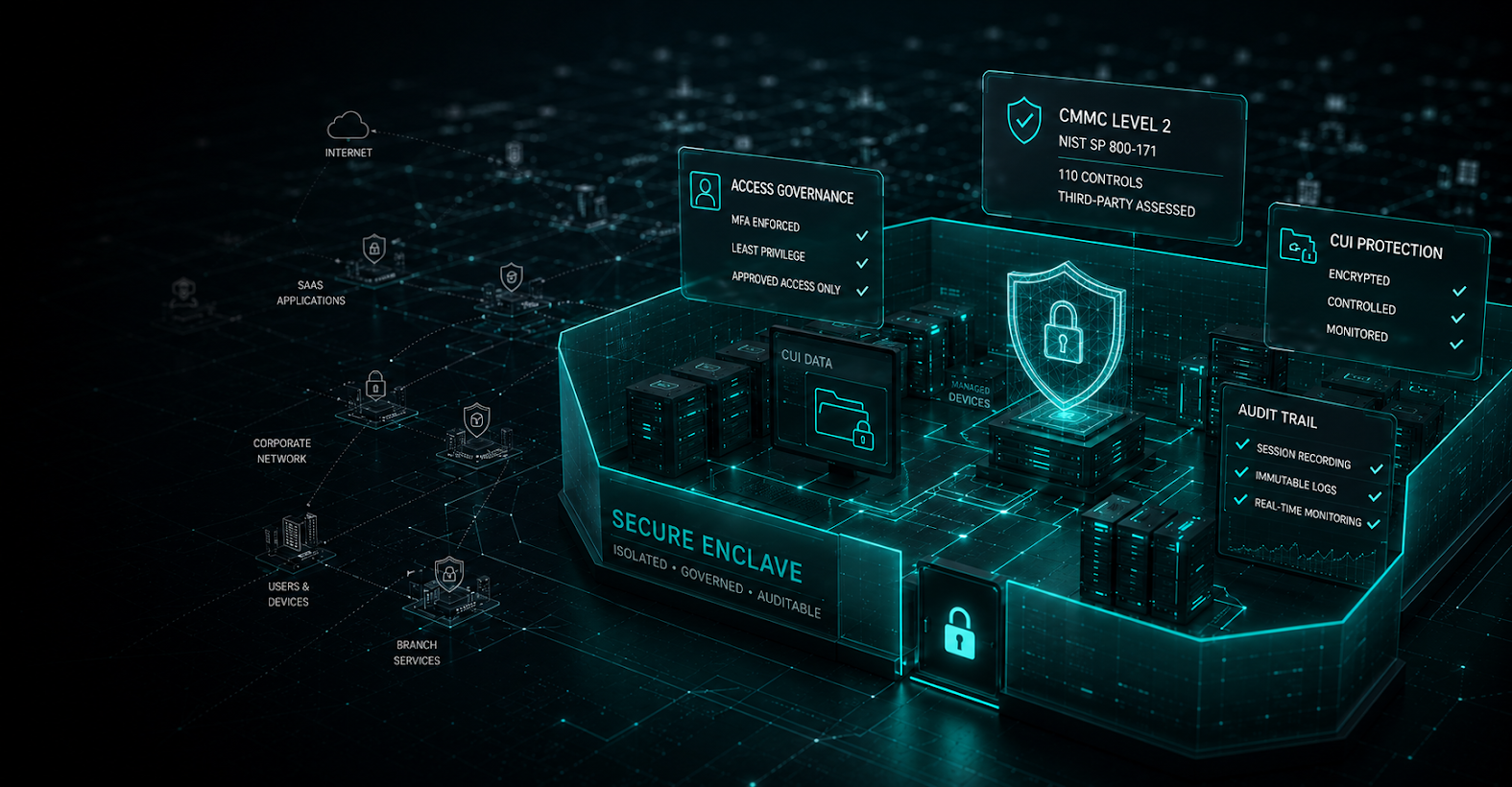
Whether you’re onboarding contractors for a federal project, spinning up temporary dev environments, or enabling offshore call centers—Tehama gives you instant, compliant workspaces that enforce Zero Trust by default. Tehama’s secure access platform is also ideal for meeting the evolving demands of CMMC 2.0 compliance. With pre-configured controls, isolation, and auditable session logs, organizations supporting the U.S. Department of Defense can fast-track Zero Trust implementation while aligning with critical compliance milestones. Read more.
With Tehama, you get:
- Secure virtual desktops deployed in under four hours
- Built-in compliance for SOC2 Type II and ISO 27001
- Real-time visibility and control over user activity and data usage
- Support for multi-cloud environments, including Azure and AWS
Zero Trust Is More Than a Checkbox. It’s the New Standard.
In 2025, Zero Trust isn’t just a security framework. It’s a business imperative. Threats are constant, endpoints are everywhere, and the cost of a breach—financial and reputational—is higher than ever.
The good news? You don’t have to build it from scratch.
Tehama’s purpose-built platform gives you everything you need to establish Zero Trust access for your hybrid workforce—without layering on point solutions or slowing your teams down.
If you’re ready to protect your business at the speed of the cloud, Zero Trust starts here.
Visit tehama.io to learn more or request a demo today.

Read More

A Checklist Tells You the Architecture Is Sound. It Doesn't Tell You It's Still Holding.
Self-Custody Is What BYOC Looks Like When the Workload Is a Compliance Boundary